Whitehead: It takes an extraordinary intelligence to contemplate the obvious.
Mea culpa. I’ve said quite a lot about symmetry and related topics, but very little about the brass tacks of the relevant math. Let us make amends.
The discovery was amazing. Mechanics is the study of moving bodies— cannonballs moving in a parabolic arc, pendulums swinging regularly from side to side, and planets moving in ellipses around the Sun. Optics is about the geometry of light rays, reflection and refraction, rainbows and prisms and telescope lenses. That they were connected was a surprise; that they were the same was unbelievable.
It was also true. And it led directly to the formal setting used today by mathematicians and mathematical physicists, not just in mechanics and optics but in quantum theory too: Hamiltonian systems. Their main feature is that they derive the equations of motion of a mechanical system from a single quantity, the total energy, now called the Hamiltonian of the system. The resulting equations involve not just the position of the parts but how fast they are moving—the momentum of the system. Finally, the equations have the beautiful feature that they do not depend on the choice of coordinates.
In the radical relation thus contemplated by Descartes, in his view of algebraical geometry, the related things are elements of position of a variable point which has for locus a curve or a surface; and the number of these related elements is either two or three. In the relation contemplated by me, in my view of algebraical optics, the related things are, in general, in number, eight: of which, six are elements of position of two variable points of space, considered as visually connected; the seventh is an index of color; and the eighth, which I call the characteristic function, — because I find that in the manner of its dependence on the seven foregoing are involved all the properties of the system, — is the action between the two variable points; the word action being used here, in the same sense as in that known law of vision which has been already mentioned. I have assigned, for the variation of this characteristic function, corresponding to any infinitesimal variations in the positions on which it depends, a fundamental formula; and I consider as reducible to the study of this one characteristic function, by the means of this one fundamental formula, all the problems of mathematical optics. (Emphases added.)
~Hamilton
Nature is lazy
If the initial point P0 and the final point P1 of the path of a ray of light are fixed, the time taken by the ray to go from P0 to P1 along a line s will obviously be expressed by the integral
since
as we have just said, is the reciprocal of the velocity. Now the line actually followed by the light is the one which makes this integral a minimum, and therefore satisfies the condition
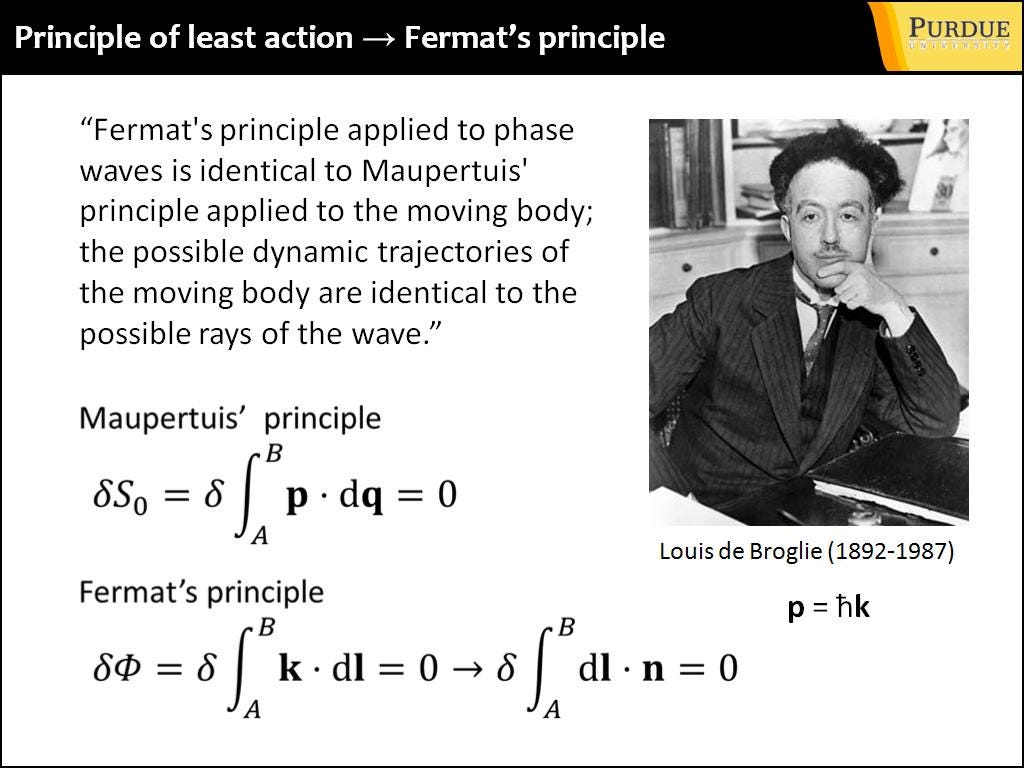
This variational equation, which sums up the whole of geometrical optics, is known as Fermat's principle.
~Levi-Civita
It is best to start from a classical action principle. It is very easy to see whether an action principle is relativistic or not: If the action quantity is Lorentz-invariant, everything has to be relativistic. So we see that it best to start off from an action principle.
We then make an assumption of localization: that each bit of action is localized in time. This is sufficient to provide a Lagrangian, which is just the action per unit time.
~Dirac
Newtonian mechanics is easy to teach and to work with without much machinery, but it has some features that can make it difficult to analyze mathematically. Physical systems and their interactions are described in terms of coordinates with velocity and force vectors all over the place, and it can be difficult to know how to deal with things like symmetries and constraints.
There are other, equivalent ways of describing classical mechanics, sometimes collectively called “analytical mechanics,” which are much easier to describe in a coordinate-free way. At the cost of a bit more abstraction, the analytical formulations have two big advantages: they make it easier to set up and solve some very complicated mechanics problems and, probably more importantly for our purposes, they make the relationship between classical mechanics and its generalizations most clear. The two most prominent such formulations are called Hamiltonian and Lagrangian mechanics, and they’re what we’re going to discuss in this article. They are, as we’ll see, two different ways of saying the same thing, but they highlight different enough aspects of the situation that they’re worth talking about separately.
The calculus of variations incorporates—and, historically speaking, arises from—the important idea of 'least action,' which Maupertuis and Leibniz independently pioneered by extending Fermat's approach to refraction. The principle of least action says the physical path taken by an object moving under given physical conditions can be found mathematically by minimizing the object's 'action.' The mathematical method is the same as that used in the calculus of variations for minimizing time in the brachistochrone problem, but minimizing the 'action' refers specifically to economizing on some 'active' quality of the motion, like its velocity, rather than simply minimizing time or distance. Mary [Somerville] described the amazing way in which the principle can produce, purely mathematically, the basic Newtonian 'laws of motion.'
~Arianrhod
It is a most beautiful and awe-inspiring fact that all the fundamental laws of classical physics can be understood in terms of one mathematical construct called the action. It yields the classical equations of motion, and analysis of its invariances leads to quantities conserved in the course of the classical motion. In addition, as Dirac and Feynman have shown, the action acquires its full importance in quantum physics.
~Ramond
An invariant is a quantity or expression that stays the same under certain operations.
The total energy in a physical system is an invariant as the system evolves over time.
~Derksen
We said at an earlier place, that every difference in experience must be founded on a difference of the objective conditions; we can now add: in such a difference of the objective conditions as is invariant with regard to coordinate transformations, a difference that cannot be made to vanish by a mere change of the coordinate system used.
~Weyl
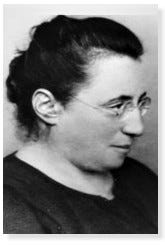
The connection between symmetries and conservation laws is one of the great discoveries of twentieth-century physics. But I think very few non-experts will have heard either of it or its maker — Emily Noether, a great German mathematician. But it is as essential to twentieth century physics as famous ideas like the impossibility of exceeding the speed of light.
~Smolin
[Noether] did some good work in invariant theory at Erlangen and was invited to Göttingen by Klein [...] and David Hilbert (1862-1943). It was as a result of working with the latter, especially after his involvement with general relativity, that she set on the investigation of the role of symmetry groups in physics in the most general terms. She read her two theorems in 1918, and Klein stressed their standing as extending the Erlanger program to physics. In her first theorem, she showed how the invariance of the action (or of the Lagrangian, Hamiltonian, or, in more modern terms, of the scattering matrix, path integral, etc.) under the action of a finite Lie group implied the conservation of a set of "charges" corresponding to the group's infinitesimal generator algebra.
~Ne'emann
Lagrange has perhaps done more than any other to give extent and harmony to such deductive researches by showing that the most varied consequences […] may be derived from one radical formula, the beauty of the method so suiting the dignity of the results as to make his great work a kind of scientific poem.
~Hamilton
If the total energy is conserved, then the work done on the particle must be converted to potential energy, conventionally denoted by V, which must be purely a function of the spatial coordinates x, y, z, or equivalently a function of the generalized configuration coordinates X, Y, and possibly the derivatives of these coordinates, but independent of the time t. (The independence of the Lagrangian with respect to the time coordinate for a process in which energy is conserved is an example of Noether's theorem, which asserts that any conserved quantity, such as energy, corresponds to a symmetry, i.e., the independence of a system with respect to a particular variable, such as time.)
The following is another difficulty with the principle of least time, and one which people who do not like this kind of a theory could never stomach. With Snell’s theory we can “understand” light. Light goes along, it sees a surface, it bends because it does something at the surface. The idea of causality, that it goes from one point to another, and another, and so on, is easy to understand. But the principle of least time is a completely different philosophical principle about the way nature works. Instead of saying it is a causal thing, that when we do one thing, something else happens, and so on, it says this: we set up the situation, and light decides which is the shortest time, or the extreme one, and chooses that path. But what does it do, how does it find out? Does it smell the nearby paths, and check them against each other? The answer is, yes, it does, in a way. That is the feature which is, of course, not known in geometrical optics, and which is involved in the idea of wavelength; the wavelength tells us approximately how far away the light must “smell” the path in order to check it.
~Feynman
Our conjecture is thus that M-theory formulated in the infinite momentum frame is exactly equivalent to the N → ∞ limit of the supersymmetric quantum mechanics described by the Hamiltonian. The calculation of any physical quantity in M-theory can be reduced to a calculation in matrix quantum mechanics followed by an extrapolation to large N.